

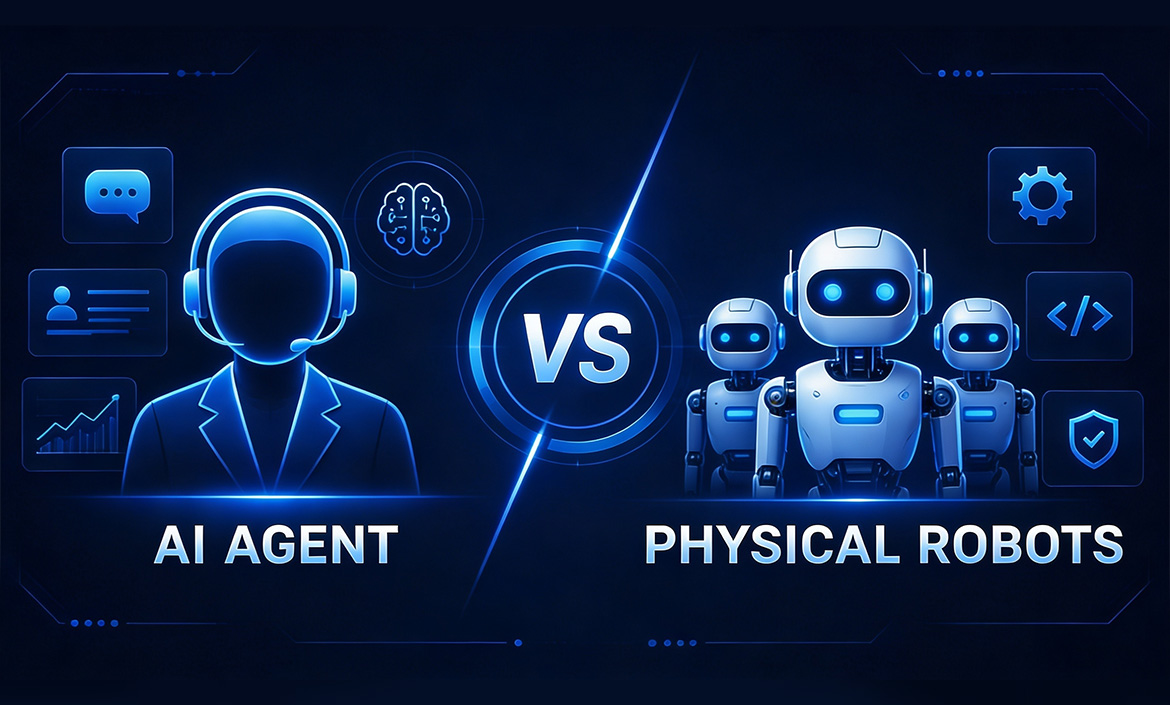
An interesting shift coming from NVIDIA, arguably the most influential company in today’s AI infrastructure landscape, is how it has started separating Artificial Intelligence into two distinct categories: Agentic AI and Physical AI.
That distinction says a lot about where the industry is heading.
For years, AI was mostly associated with assistants that could generate text, answer questions or summarize information. But NVIDIA’s view is that the next phase of AI is not about generating content – it’s about taking action.
And those actions can happen in two very different environments: the digital world, and the physical world.
Agentic AI
Agentic AI refers to AI systems that operate inside digital environments.
These systems can:
- Make decisions,
- Execute workflows,
- Use software tools,
- Interact with APIs,
- Coordinate tasks,
- Automate operations with some level of autonomy.
These are the types of Agentic AI systems we at Genesis have been actively implementing across real business environments, with our product Genesis AI helping companies automate operations, reduce repetitive manual work and create high-impact efficiency gains across their workflows.
Our Agentic AI systems are designed to automate operational processes, orchestrate workflows across platforms, and reduce repetitive manual work inside real business environments.
Physical AI
Physical AI is a different category entirely. Instead of operating software, it operates in the real world.
This includes:
- Humanoid robots,
- Autonomous vehicles,
- Warehouse robotics,
- Industrial automation,
- Drones,
- Embodied AI systems.
These systems need capabilities that go far beyond language:
Computer vision, spatial awareness, sensor processing, motion control and real-time decision-making.
In simple terms:
Agentic AI performs digital work.
Physical AI performs physical work.
Why NVIDIA Created This Distinction
The reason NVIDIA separates these categories is because, although both are “AI”, the technological requirements are fundamentally different.
Agentic AI depends heavily on:
- Reasoning,
- Orchestration,
- Cloud infrastructure,
- Integrations,
- Long-context inference.
Physical AI depends on:
- Robotics,
- Simulation,
- Edge computing,
- Low-latency processing,
- Real-world spatial understanding.
From NVIDIA’s perspective, these are becoming two massive industries on their own.And strategically, this distinction also reflects where the company believes the market is heading next.
✅ The first AI wave was generative AI.
✅ The second wave is agentic AI.
✅ The next wave may be physical or embodied AI.
What makes this especially important is that the two worlds will likely converge over time.
Future robots will not simply move objects. They will reason, plan, communicate, interact with enterprise systems and coordinate tasks autonomously.
The “brain” will be Agentic AI.
The “body” will be Physical AI.
And that may ultimately become the next major computing platform after mobile and cloud.
One of the reasons Physical AI is advancing so quickly is because many companies have been collecting real-world data for years, long before the current AI boom.
A good example is Tesla. Every Tesla vehicle on the road continuously generates massive amounts of driving data: road conditions, human behavior, edge cases, obstacles, weather situations and real-world decision-making scenarios. That data becomes training material for autonomous systems and future Physical AI models.
The same is happening in other industries. Warehouse robotics companies, for example, have spent years collecting operational data from cameras, sensors, logistics systems and worker interactions inside real environments. Every movement inside a warehouse helps train systems to better navigate, predict, optimize and eventually automate physical operations.
What makes this especially interesting is that the line between Agentic AI and Physical AI may eventually become blurred.
Physical AI generates real-world behavioral data that can improve reasoning models and decision-making systems. At the same time, Agentic AI provides the orchestration, planning and autonomous execution layers that physical systems increasingly need.
In many ways, the two categories evolve together: Physical AI gives AI systems eyes, ears and mobility, while Agentic AI gives them reasoning, coordination and operational intelligence.
As businesses move from AI experimentation into real operational deployment, the ability to build reliable Agentic AI systems is quickly becoming a competitive advantage.
At Genesis Digital Solutions, we help companies design and implement Agentic AI solutions capable of automating workflows, orchestrating operations and integrating intelligence directly into day-to-day business processes.
The shift from software tools to autonomous operational systems is already happening, and the companies adapting early will likely define the next generation of digital businesses.
Contact us to explore how Agentic AI can be applied inside your business operations, products or internal workflows.

